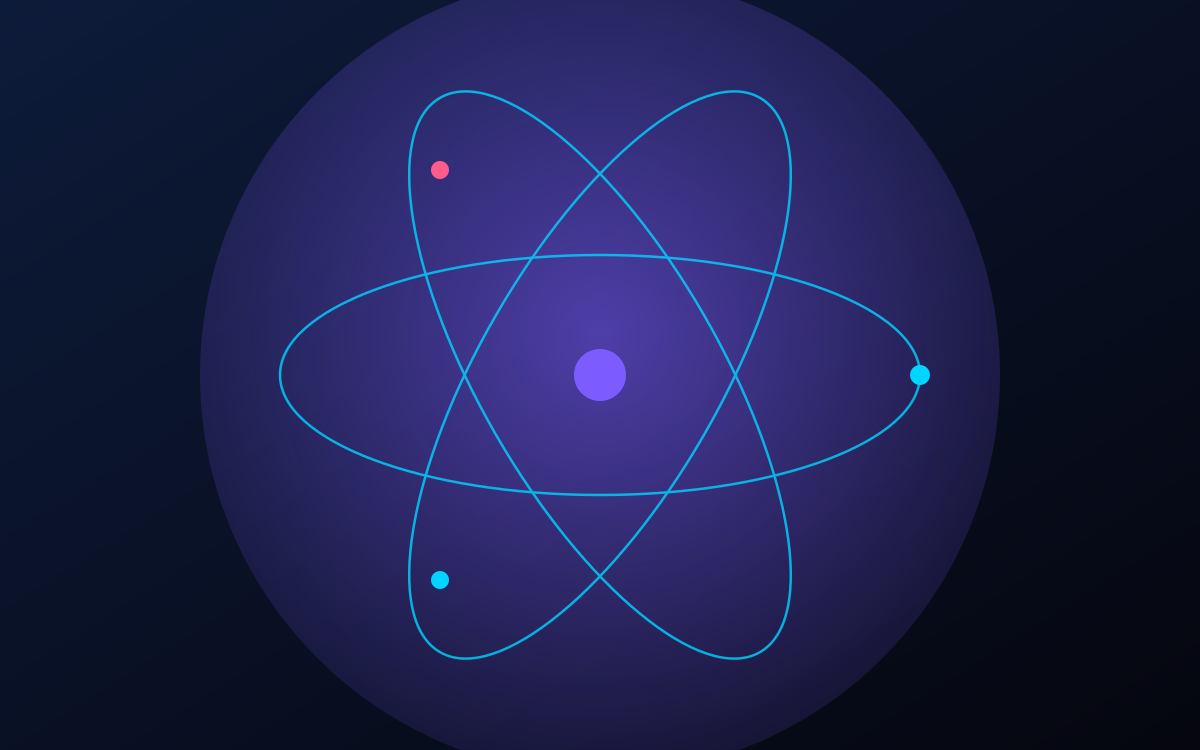
Quantum computers are not faster laptops. They use the strange rules of quantum physics to tackle problems that make classical computers fail.
The bit versus the qubit
A normal bit is either 0 or 1. A qubit can be both at the same time through superposition - and multiple qubits explore so many possibilities in parallel. With each additional qubit, the space of possibilities doubles, which is why just a few dozen qubits represent an astronomical number of states.
Imagine a labyrinth: a classical computer tries each path one after the other, a quantum computer tries all paths at the same time.
Entanglement - the invisible connection
Two entangled qubits behave like a single system, no matter how far away they are. If you measure one, the other is also certain. This connection allows computational operations that are classically impossible and is the key to actual computing power.
Why it is so hard
Qubits are extremely sensitive. Even the smallest disturbances – heat, vibration, radiation – destroy their condition. That's why many quantum computers operate near absolute zero, colder than space. Most of today's research is not about more qubits, but about correcting their errors.
What they really solve
- Drugs: Simulating molecules that are too complex today.
- Materials: Designing better batteries and superconductors.
- Encryption: Today's security procedures could be crackable
- Logistics: Calculate huge optimization problems in seconds.
Not a replacement, but a supplement
Important to understand: A quantum computer will never replace your laptop. It is useless for emails, videos or spreadsheets. Its strength lies in narrowly defined problem classes where classic computers reach their limits. Both worlds will work together - the classical computer controls, the quantum computer solves the special problem.
Why precautions are necessary today
A particularly sensitive point concerns encryption. A large part of today's security on the Internet is based on the fact that certain computing tasks are practically unsolvable for classic computers. A sufficiently large quantum computer could crack exactly these tasks - and thus theoretically make encrypted data readable.
Such machines do not yet exist. But attackers could intercept and store encrypted data today in order to decrypt it later. That's why experts are already working on "quantum-safe" processes that will also withstand future quantum computers. This silent change in the background is one of the most important consequences of a technology that has not yet reached everyday life.
The machines are still error-prone and rare. But anyone who understands what they can do sees one of the biggest revolutions in computing technology coming - and at the same time understands why quantum-secure encryption is already being worked on today. You don't have to be a physicist to understand the implications: this is not a faster version of what we know, but rather a fundamentally different way of calculating. How deeply it will shape our everyday lives will be decided in the next few years - but whether it will do so is hardly a question among experts.
Quantum computers simply explained: Why they could change everything
𝕏 Tweet


Be the first to comment.